Before the Timer: How Cooks Kept Track of Time
Kitchen timekeeping paired household clocks and familiar cues to prompt a closer look. See how cooks could use routines without mistaking them for exact measures.
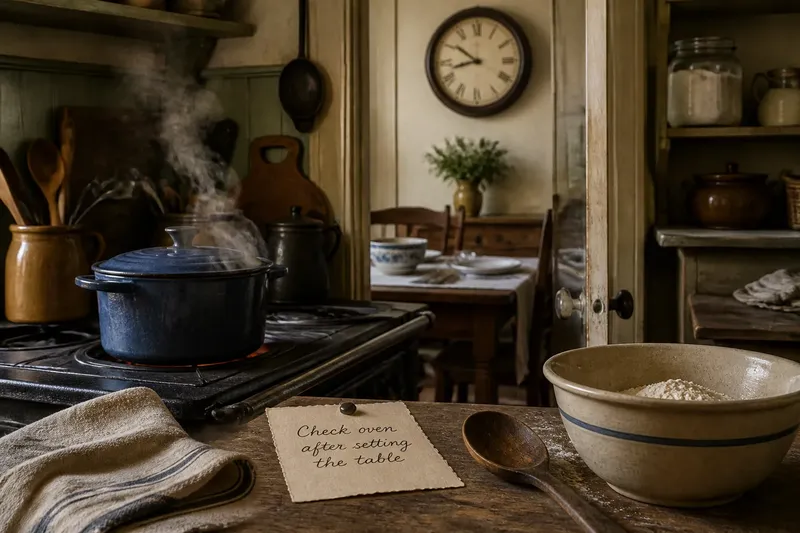
A pot murmurs on the stove while someone sets the table, and the kitchen clock hangs just beyond the doorway. In a household without a timer to hand, that clock, a remembered routine, or a change in the food might prompt a cook to look again. The details varied by home and circumstance; no single method describes every kitchen.
What could a kitchen clock tell a cook?
A clock could show that time had passed. It could not tell a cook what a particular pot needed. Heat, cookware, ingredients, and the amount in the pan all shaped what happened between glances at the dial.
In some homes, the clock was in a sitting room or near a doorway rather than beside the stove. It offered a shared reference, but the cook still had to connect the passing time to the food. A clock was a prompt to pay attention, not a verdict on what was happening in the pan.
Household routines could offer another prompt. Setting the table or finishing a nearby chore might remind someone to check the stove, though such tasks did not mark an exact interval.
How could a cook keep a reminder in view?
Remembered timing is easy to lose when several jobs compete for attention. A note on a slate, a utensil set beside the work, or a request for someone nearby to call out a reminder could make the next check more noticeable. These are practical possibilities, not a claim that every household used the same approach.
Imagine a cook puts a covered dish in the oven and plans to check it after a chore in the next room. The cook asks a housemate to call them back and places a note by the doorway. The housemate’s prompt and the visible note offer two reminders; the cook returns, inspects the dish, and decides what to do next by its condition and the recipe guidance.
Put a reminder where you are likely to encounter it.
Which cues from the food are worth noticing?
A change in aroma, a soft hiss, or a visible shift at the edge of a dish may prompt a closer look. These cues come from the cooking itself, but they are not universal signals. A sound can disappear beneath conversation, and an unfamiliar smell may be difficult to interpret.
If a cue seems unreliable, ask whether it was masked or unfamiliar. Someone working in another room may not hear a faint sound; a cook using a different pan may not recognize its usual behavior. A clock reminder or deliberate visual inspection can help bring attention back without treating any one cue as proof.
Why did household routines matter?
Kitchen work often fit into the rhythm of a home. A meal might be coordinated with a household clock, the return of family members, or a sequence of chores. Such landmarks could help organize attention, though they could not make every cooking task predictable.
In a household where work was shared, a person passing through might remind the cook to check the oven. That kind of cooperation depended on the people and routines in a particular home; it was not a uniform system. A changed schedule, ingredient, or piece of cookware could also make a familiar pattern less useful.
Keep a routine as a prompt, and inspect the food when the prompt arrives.
What should you do when a timing cue is unreliable?
What if you keep forgetting to check?
Move a note or clock into your usual path, or ask someone nearby for a clear spoken reminder. If neither is practical, use a timer you can hear or see; then return to inspect the food.
What if the clock and the food seem to disagree?
Use the clock to choose when to look, then judge the food by its condition and the recipe or product directions. Elapsed time alone cannot account for every difference in heat, ingredients, or cookware.
What if you cannot hear the usual sound?
Reduce competing noise or use a visual prompt, if practical. Treat the missing sound as a reason to check rather than evidence that nothing has changed.
What if a smell or appearance is hard to interpret?
Compare what you see with the intended result and consult dependable recipe or product directions. If food safety is uncertain, follow ordinary food-safety guidance rather than relying on a remembered interval.
What did a mechanical timer add?
A mechanical kitchen timer could hold a chosen interval and sound an alarm, so a cook did not need to keep that interval in memory or watch a wall clock. Its ring marked a moment to return and pay attention; it did not decide whether to stir, stop cooking, or serve.
Digital timers carry the same distinction. A countdown can prompt a check, while the cook still uses observation and relevant cooking guidance to choose the next action. Timers track elapsed time; inspection helps interpret what that time has meant.
How can clocks, timers, and cues work together?
A clock provides a general reference, a timer calls attention to a chosen interval, and a change in the food gives the cook something to inspect. A routine or another person can help bring attention back, but none of these prompts replaces judgment about the food.
For kitchen timekeeping, the useful distinction is between tracking time and interpreting the cooking. Set a reminder to return, then look, listen, and use dependable directions to decide what happens next.
When a familiar habit stops working, change the prompt: move the clock into view, choose a cue you can notice, or ask for a reminder. The best prompt is one you will actually encounter before the food needs another look.